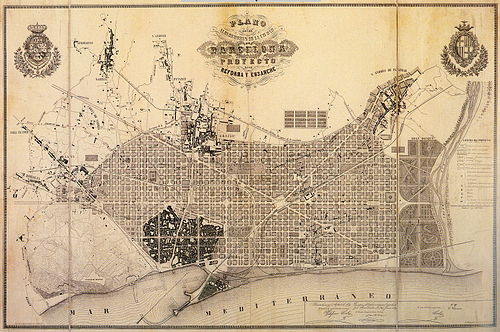
Part of the Barcelona bourgeoisie reacted with speculative eyes in front of Ildefons Cerdà’s wit, when he presented his winning project of an urban grid to make Barcelona the supreme ideal of a garden city; these bourgeois were the owners of the terrain where had to be carried out the great project of L’Eixample, and for that they wanted to get full possible advantage.
The cake had to be shared because another part of bourgeois society accepted, with courage and even with enthusiasm, the idea of creating a Barcelona as the great genius Cerdà proposed. But also wished to get out of that tightness in old quarter, created by ancient city walls, and also out of the moisture of the port. In addition, Catalonia was having a time of prosperous economy coming from the Industrial Revolution and from its trade. However, there remain two representative examples that adapt to the plan of the great urban planner: Méndez Vigo passage and Permanyer passage, where it can be found low buildings with outdoor gardens.
Modernism did not want to miss the opportunity and, with their works, splashed the terrains of the City that had to be built. But this artistic phenomenon did not entered in the great project of Cerdà because it proposed blocks of low buildings with only two facades at right angles, leaving the interior visible and with abundant vegetation. Modernism is lover of curves, of filled spaces, wide and high, that open to light; its architects thought in big projects and in wide spaces in order to place on record, somehow, that they had soul of artist.
City officials tried to navigate gable: they liked the excellent buildings of the new art, and also the touches of modernity that were been given to the City; also, with some tweaks, the urban grid projected by Cerdà was being fulfilled. Certainly Barcelona was not a garden, but its wide streets allowed to fill them of deciduous trees to give comforting shade in summer and to let sunlight pass in winter: banana trees were the chosen. In some streets were put some banks to allow some rest and to give the impression that, although it was not a garden, it could be like to a park. We should not forget that the City bought terrains for large urbanism projects as it happened in the one for construction of the current Plaça Catalunya.
At that time, they were met in Barcelona art geniuses internationally renowned whose works are nowadays a worldwide tourist enchantment. It was impossible to contain the creative impulse of such great personalities, both because they were willing to leave their footprints in residential buildings, as venturing into unbuildable spaces to convert them in authentic art. Major sponsors were not lacking to carry these projects out. Thereby we can enjoy the Güell’s Park, Sant Pau’s Hospital or the charm of Montjuïc Park, permanent headquarters of universal exhibitions.
Was the Cerdà plan betrayed? Or he would look kindly the results of the group to which belonged?